Monday, February 26, 2007

The Saucer


Through years of therapy I have finally come to grips with my reality. My energy and focus used to be the metaphorical size of large platter. About two-thirds of that platter was taken up by events that I officially budgeted time for in a disciplined fashion and one-third of it I used in an “off-budget” ad hoc fashion. I shoved stupid things like "housework" and spontaneous things, like a three course meal for eight people and poetry reading into this part. So I had my life set-up so that the acknowledged portion was always cool stuff like school or my job at USAID. There were many off-moments despite how tired I felt (as if I knew the meaning of the word back then) and I got all the bullshit done without every really acknowledging it as a serious part of my day. Plus I did fun off the cuff things.

Now my energy and focus are the size of saucer. That saucer is a little under metaphorical size of the third of a platter that I used to routinely blow off as irrelevant. In order to survive, I have to do things like eat, cook, wash my clothes, etc. I can't fit that into some off-budget moment. There are no off-budget moments. Feeding, cleaning and making sure I'm properly medicated, etc. is now a third of my life. The result of my inability to comprehend or accept this meant that for the four years before I knew Craig, I lived in a complete shithole. Craig and I do better than I did alone, but it takes way more time. But simply but, self-maintenance was never allowed onto the official budget before, with obvious results.

The saucer has two other sections. Teaching a class I've already designed takes one of those sections. If I'm designing a course or getting all the kinks out of it on the second run, that takes the last third. If I study an easy language (i.e. Hebrew), that takes a third of the plate. Writing takes a third of a plate. I'm bombing Hebrew at the moment, because there are four things on a plate with three sections. Predicatably, I've started bailing the Hebrew canoe and have stopped writing again.

No more Hebrew next year. Hebrew is an easy language. Two years are all that it gets. I apply for grants and teach first quarter. I write and teach second and third quarters

Saturday, February 24, 2007

Magic Doors


Kirk sent me a really good letter a few days ago in response to some of the stuff I blather on about here. His letter has really set me thinking. There were a lot of very personal parts that, obviously, he wouldn’t appreciate me reprinting here, but I’m rather hoping he won’t mind me reprinting the more philosophical parts. It’s really good stuff.

> It’s funny. I don’t miss sexual innocence at all. I miss
> being able to dream without thinking about what dreams cost.

I totally understand this. I certainly don't miss sexual innocence but then again I lost my virginity in high school, which seems like a long, long time ago so I barely remember the innocence at all. I think the dreaming part coincides with the idea I mentioned above about how I just don't have anything to talk about any more. When we were younger we could talk all day because much of what we talked about involved our dreams. When you have what looks like an entire unknown future ahead of you there is a lot to think of, ponder over and dream about. It seems once you get into your 30's, especially your mid-30's, your future starts to shrink and become somewhat known, or at least predictable. All of a sudden you are making 10-year, 20-year, 30-year commitments with student loan payments, mortgages, 401(k) plans, new cars or other expensive toys. You start saving long-term, planning a family and raising children. There is no more dreaming because you now know what the future holds in store for you. Sure, life is unpredictable and you may wildly go off on some tangent, but for the most part you start to see the most likely path you will follow and your future becomes mapped out. In many ways this sucks, but there are some positives. Life is generally more stable, you will generally have the means to actually realize some of your dreams from your 20's, you begin to develop new dreams that actually are attainable. I would imagine one of the best of all positives is the satisfaction from raising children. I certainly miss the innocence but I am definitely enjoying this next stage in my life.

Wow. You really nailed that, brother. It’s harder to talk because we’re plugging away at making dreams a reality and not dreaming anymore. That perfectly defines the moment when youth ends and middle age begins. You can tell by the pattern of the conversation. When I was young, I hated routine. I hated it because the repeating pattern wasn’t my own. It took me from my dreams and chained me to a reality I found hateful. I began to develop a passion for work when childhood ended and youth began, when I started being able to shape work toward my own dreams. I started to love work. But it’s one thing to throw yourself into work with passion. It’s another to actually learn to work with skill. It’s so goddamned hard to build something worthwhile, to make a dream come true. The struggle to learn how to do that under the constraints of my illness has broken my youth. I am a man now. The word “man” now means something different. It means being someone who builds patiently—a slow boring of hard boards. It takes passion and perspective. A young man has passion. The point of middle age is to temper it with perspective.

I thought that the reason I can’t see into the dream world anymore is because I now know what dreams cost. I was passionate when I was young, but I lacked perspective. I’d do anything to make my dream into reality. I now know just how deep that anything can run. And while I believe that if I knew what my dream would cost me when I started, I’d still probably have followed it anyway (God help me), I now know that I have limits. I won’t do just anything. There is a point where I will give up the quest.

I don’t think I could have said it before you wrote me, but I realize that I believed that the reason I no longer see into the dream world is because I had lost that purity of intention, that willingness to sacrifice everything. That’s a boy’s fear. The answer is simpler. I can no longer see into the dream world because I am no longer searching for a dream. I found my dream. I’m not looking anymore.

I have to believe that when the day comes to gaze into the dream world again, that, even knowing what dreams can cost, I will have the courage to dream again and walk through that magic door. And, Kirk, I think I trust myself that much. Maybe learning to do that is the whole point of growing up.

I like Brett Favre coming back because he is entertaining, but I have my doubts about how well this affects the Packers long-term. Favre is obviously a fading (some would say already faded) athlete surrounded by some very promising young talent. He is a very, very average QB statistically which is sad because of how spectacular he was ten years ago. I believe he threw for 18 TD's and 18 interceptions last year, which is pretty bad in an era in which a QB is expected to throw twice as many touchdowns as interceptions. In the 80's and early 90's throwing 20 touchdowns and 15 interceptions was considered a good year, nowadays a good year would be 30 touchdowns and 10 interceptions. At the very least you want your QB to throw 20-25 touchdowns and 10-12 interceptions.

Beyond his statistics, think about this logically. Quarterback is probably the toughest position to learn for an incoming rookie. The Packers have some good young talent on the offensive line and in parts of the defense. They need a running back and some receivers but they definitely have a solid young base to work with. As long as the team continues to draft well they could be a contender in a few years. By that time, however, Favre will be eligible for social security and given his decline in effectiveness over the last 3 years or so you can expect him to be pretty bad. What you really want is to find a younger quarterback now and have him develop along with the team so they all peak at the same time. What you don't want is a team where the quarterback is on his last legs while the rest of the team is peaking. What you also don't want is a brand new rookie quarterback when the rest of the team is peaking. That's a recipe for disaster! The Chargers went through a somewhat similar situation this year - a brand new quarterback surrounding by a team full of talent just reaching its peak. Fortunately for the team, however, the new quarterback turned out to be pretty solid. This is the exception, however, as most first-year quarterbacks struggle to reach the "sucky" effectiveness level. I think the best idea long-term for the Packers is for Favre to retire and allow the team to bring in a younger quarterback who will be around 5-10 years.

The one other solution is to keep Favre until body limbs start to fall off, then bring in a proven veteran via free agency. This option is rather expensive, however, and may cause the team to dump some of its talent simply to fit under the salary cap. This could work, though. Still, I think the best long-term solution is to get an effective young QB to take over and allow Favre to ride into the sunset as soon as possible.

And writing like that is why I keep getting on Kirk’s case to start a football blog. He’s an excellent analyst. Normally, I’d dig in and fight, pull up some numbers, discuss scenarios, do the routine. I mean, the gauntlet’s been thrown. But this blog began nearly a year ago with a long letter defending Brett Favre to Kirk Anthony. Fuck it, anyone who wants to can read that again. I won’t write the same letter twice.

Truth is, Kirk, I could give a flying fuck if Favre retiring is the best thing ever for the Packers. I need to see Brett Favre lead the Packers to a victorious season one last time. I’ve worn his shirt for nearly ten years now, but I didn’t wear it because he was a hero. I wore it because he was the all-powerful quarterback of the Green Bay Packers. He was our boy. And he was damned good. And he won, game after game. Two years ago, that ground to a halt and he had to look at his illusions and what meant something in life. I got a lot of ribbing when Favre cried during that interview after we beat the Bears, but in my opinion, that was one of the most important moments in his career. Favre finally appreciated what he’d had.

In 1998, I reached the acme of my strength. By 1999, I was broken. I lost in every single way I can imagine. Quarterbacks hit old age early because of the demands of the sport. It’s rough to reach the acme of your power in your twenties and then have the rest of your life as an epilogue. I got sick. I know what it’s like for your life to be over and to have to build a completely new life in your mid-thirties with way lower expectations. Favre will be in the Hall of Fame and will wipe Dan Marino’s name off most of his records next year. I’ll never do the equivalent. I’ll be lucky if I get a tenure track job somewhere.

I’d like to see Favre do it one more time. For me, who’ll be an eighth year grad student. I need to see him do it with you and everyone else ragging on him. No one says anything to me, but I know how it looks. Seeing him win again would help me believe I can make it.

Kirk was surprised I watched Fight Club. I’ll write about that next time.

Sunday, January 21, 2007

Jenni and Talal at the Slush Bowl


At long last, here’s the photo of Jenni and me at the Slush Bowl. And, yes, folks that is a genuine cheesehead hat and my hoodie is indeed blaze orange.

Monday, January 15, 2007

We Beat the Fuckin’ Bears
(and That's What Counts)


Now and then you need something that’s good for your soul. And on New Year’s Eve, we beat the fuckin’ Bears. That was good for my soul. I watched the game on my brother-in-law’s 42-inch TV screen. He’s got a pretty cool sound system hooked up to it. The Pack dominated the game. Rex Grossman, that limp-dicked loser, got pulled and Brian Griese threw the Bears’ only touchdown. The Packers offense came alive. Donald Driver hoisted Brett Favre—a moment that perhaps defines our season, as the Packers are becoming a real team again. And Favre cried in the interview at the end. I hope he comes back, but you know, I’m okay with it if he doesn’t. And it's not that I won't miss him.

It’s funny. For the first time I feel like the bastard is grateful for having been Brett Favre. He’s beginning to be likeable to me as a person. Yeah, I’ve worn his jersey for years. He’s Brett Favre, after all—legendary quarterback of the Green Bay Packers. I admit it. I’m in awe of him. But he’s been an asshole for a lot of his life. For the first time, he appreciated what he had. It did my heart some good. At least, if he retires, he sees clearly what he’s taken for granted and can be grateful before it’s over. He’s only a year older than me. Maybe, just maybe, he's begun to learn what football has to teach him about life. And if he has, then it hasn't been a waste and it was good that he came back. Because life is more important than football.

I’ve been dealing with something of a personal crisis over the past two weeks. That particular Arab-Israeli class was one of the hardest classes I’ve ever taught. You see, the evals weren’t good by my standards. I mean, I got an average of 4.1 out of 5 points on all the indicators—the numbers were fine. The statistical breakdown made it fairly clear that there were only one or two students who really hated my guts. That’s certainly acceptable—my guts are not there for them to love. But, basically, the general consensus on all the written eval sheets was “This class is really interesting, but it’s too damned hard.” That evoked a great deal of bitterness in me. I did tell them after all, that the course was hard. It’s the Arab-Israeli Conflict. There’s nothing easy about it. That said, their course mean was strikingly normal. The class clearly wasn’t too hard for them to handle. It was simply harder than they wished to work. And between their complaints and their numerous personal problems, they drained the soul out of me. That left me resentful, because they didn’t match my commitment to them. They just whined and bitched and killed any affection I had for them.

Of course, Craig would say to me (and he’s right) that I have to match their level of commitment. One cannot expect them to match mine. Jamie Mayerfeld once gently reminded me, “Talal, this is the most important thing in our lives, not the most important thing in theirs.” And he’s right. My emotional response to this course is a direct result of a failure in discipline on my part. My guts are not there for them to love. I try to leave them with the joy that can only be found in a genuine encounter with knowledge. But ultimately, Plato is right that education is about turning a person in the right direction and praying that they see what they need. I’m better at it than most, but at the end of the day, it's they who have to see, not me. More than just my will is at work in this process. And, ultimately, and what’s more to the point, whether they like me is not is not material. I can’t be hurt because we didn’t connect. It’s great when it happens (and has happened often enough that I know that I don’t suck at this), but ultimately my guts are not here for them to love.

Like Favre, I have a deeply rooted need to believe that I can be the difference maker. The last two seasons have taught Favre that football is a team effort. Now don't get me wrong—Favre was never the sort of asshole that Terrell Owens or Randy Moss are—Favre’s a genuine leader. He doesn’t have delusions that he doesn’t need the team. But he used to believe that no matter what went wrong, he could always make the difference. The past two years have been a sharp lesson to him that for a man to be Brett Favre, you need more than raw talent and discipline. You need a supporting cast. Yeah, Favre has made the difference for the Packers for a whole decade. But there are no-win scenarios. And some seasons, you can’t win for losing. Yes, I made errors last term. But ultimately, if any class makes it to the next level, it relies on more than my will and skill. I worked goddamned hard last term. But that isn't enough. They’ve got to want to go there. And now and then, you get a bunch that just aren’t that interested in working that hard, just like sometimes, you’re rebuilding.

I need to remember the victory over the Bears. Even in a lackluster season, there are golden moments. And there were golden moments in that class. I’ve got to remember my love of the game. Favre seems to have learned to be grateful for being Brett Favre. I need to remember to be grateful for being me. I’m a pretty lucky bastard. I get to teach stuff like the Arab-Israeli conflict for a living. And I need to get the head straight about that last course. Life is a slow boring of hard boards. I can’t lose my passion or my sense of perspective.

Saturday, January 13, 2007

Fog, Part I


I promised Sean that I’d explain what I meant by “fog.” He asked, “How problematic is it? As someone who is absent-minded naturally how different is it? One article said you forget why you went to a store. You forget people’s names etc. This happens to me often, so I write everything down. I am assuming there is something much more serious and sinister.”

Yes and no, Sean. It is a very natural response to trying to use empathy to understand the problem (indeed, that act is the very foundation of social science). Moreover, you are right in believing that you have experienced what I experience—indeed everyone does experience absent-mindedness. The practical difference is not qualitative. It’s quantitative. A healthy person does not experience absent-mindedness as many as twenty to thirty times a day. For me, this is quite normal.

Recall not memory

You are right, however, that this is a problem that normal people have. We all experience small recall problems. We search for a word that is on the tip of our tongues. We forget someone’s name. We got to the refrigerator only to forget what it was that we were getting. These are recall problems—the memory is still imprinted in the cerebral cortex, it can still be accessed. If you have a memory problem (an illness such as Alzheimer’s, for example), the memory itself is being destroyed and, as personality is a direct product of memory, your identity is destroyed with it. You know less and less that you have a problem and everyone you love suffers as your personality and every memory you have of them are destroyed and they get to watch the walking corpse.

A recall problem is nowhere near as cataclysmic. You can remind me of what I’m forgetting and, almost without exception, I’ll remember it. While you are out of sight, I may forget that I was supposed to do something with you, but my memory of you and what we were supposed to do is still there. If I have a list of things to buy at the store, it will jog my memory. Someone with Alzheimer’s will not even recall the context of the list or know what to do with it.

I think a good analogy is to think of a computer. A computer has a processor, memory and a hard-drive. My processor is fine. I think pretty quickly and accurately. My hard-drive is fine. People with Alzheimer’s essentially have a bad hard-drive that is destroying all the data on the disk. My problem is that I have shit for memory. Just like a computer that’s running the latest software with low memory, I can still do the task. It’s just slow. I can still do virtually all the things I did before. I simply cannot do them efficiently.

Some of the tricks a normal person uses will work for me too. Writing things down is key. But unlike a normal person, I need to make sure that I get things written down where I can see it when I can actually do something about it. For example, my mom can call me earlier in the day twice to remind me that it’s my father’s birthday. But unless I write it where I can see it in the early evening, I’ll completely space. It doesn’t matter that my mother called me twice to remind me. And it doesn’t matter how important the person involved is or how much I love them. I’ve spaced on Craig’s AA birthday, my mom’s birthday and most of my friends can attest that it’s been years since I remembered their birthday, if indeed, they ever knew me before MS. Plus, recall that multiple sclerosis is a nerve conduction problem. There are good days and bad days. Some days I remember without a reminder. Some days twenty reminders won’t be enough. There’s no way of telling which kind of day tomorrow will be.

Concrete Object fields

Coordinating between different times and spaces is very difficult for me. This is hard to explain. I had to develop a vocabulary to even explain the problem for myself. So that’s how I have to explain it to you. In order to relate to a set of discrete objects or ideas, we construct what I’ll call “object fields.”

Object field: a cognitive “space” delineated by networks of associations that lead the mind to group certain objects together as an interrelated and discrete whole.

Meta-object field: a cognitive object field that contains other object-fields and that is constructed to coordinate between them

The object fields that are the simplest for me to deal with are those that are based on real physical locations where I happen to be. The advantage in this case is obvious—I can see the space and that sensory stimulus is a constant reminder. It’s hard to forget something that you’re looking at. But even when dealing with physical object fields, I have problems, particularly in complex work areas such as the kitchen.

Say I’m making a salad. I leave my cutting board and the knife on the counter and go the refrigerator to get some vegetables. When I open the refrigerator, I’ve entered a new object field. Often, when I move from one object field to another, I forget what I’m doing. So I’ll be standing there looking at the refrigerator trying to remember what I was doing. So I’ll have to look away from the refrigerator and look back at the counter. When I see the cutting board and knife, they jog my memory. So far, so good, right? That happens to everyone.

What doesn’t happen to everyone it that when I look away again, I’ll forget again. Lather, rinse, repeat. On a bad day, it may take three or four repetitions before I get it right. Imagine accruing all of those time losses every time you change object field (if you open a desk drawer, you’ve just changed object field—we change object fields just that often). The time losses rack up. Bottom line: I can still make a great salad, but you can do it faster, especially since you don’t have the recall problem and are likely to be faster with a knife than me. Being slow with a knife, however, has nothing to do with MS. I’ve always been a klutz.

Object Fields and the World of My Imagination

Now, I’m allegedly an intellectual. Lots of what I do happens solely in the mind. There are no physical objects to glance back at to remind you. Yes, there is a physical bunch of people who are the Congress of the United States, but no one who studies them has them all seated in a room. Moreover, certain things like “institutionalization” are rather abstract. Fortunately, most of those object fields are part of my long-term memory. But you see, it’s my job to invent new concepts. Now my imagination still works just fine and that was my real academic asset, as not everyone has one. So I can still do this job. But now, I’m way slower.

In my imagination, there are all sorts of connections. One thing hooks up with another and another. There’s always this huge, amorphous incoherent “structure” that feels like it’s the Theory of Life, the Universe and Everything. Well, back when we were first-year grad students my buddy Peter said (and he had a point), “Talal, you can’t write the Theory of Life, the Universe and Everything. You have to pick one. So what’s it going to be: life, the universe, or everything?”

Well, what I would have done before MS was to loosely define the contours of the whole pseudo-structure in my mind, find the general boundaries of the part I wanted to write up and distill that bit into a coherent, well-crafted theory. But my short-term recall is shot. Trying to cut out the bit in my mind that I want is virtually impossible. I don't know the pseudo-structure very well, so it exists only in short-term memory. I have to do two things at once: recall the whole structure and then step away from it and criticize it. That's too much brain-power at one time. I keep losing focus on the outline of the large structure as I explore it to criticize it. In the seconds in which I lose track of the process, I start following all the luminous connections that my imagination has generated and, as a result, keep losing track of the task.

What I’ve discovered that I have to do is do my best to spend a few months writing a sixty-page document that is a rambling mess but contains a great deal of the amorphous pseudo-structure in my head. Then I can see the pseudo-structure and don’t need to hold it in my head and criticize it at the same time. Yes, I'll still get distracted, but my eyes will still be resting on the same shitty passage I was critizing before and that will pull me back on task. I don't get as lost that way.

After doing the write-up of the pseudo-structure, I need to wait a while before proceeding to criticism, because trying to force that much material out of one’s imagination into the daylight at one time is exhausting and really fucks with your emotions. So a few months later (yes, that long) I can pick up the rambling mess and use all my brain power just for criticism. I don’t need to recall anything, because it’s right there on paper in front of me. Plus, having given birth to far more of the pseudo-structure than I needed, I can probably distill a few papers out of the mess.

But it’s slow. Worse, it looks like you’re not really working most of the time, especially to people who are not writers. That’s pretty humiliating, because I’m trying really hard the whole time. And you burn out several times on the road and wind up playing Civ 3 or Spider Solitaire just to get you mind off of it and let stuff work at the back of your head. That doesn’t build other people’s external confidence either. But you’ve got to take those sort of breaks if you’re to get the job done.

This is quite a mouthful. I’ll start with meta-object fields next time.

Saturday, January 06, 2007

That Cheeky Bastard Dinur


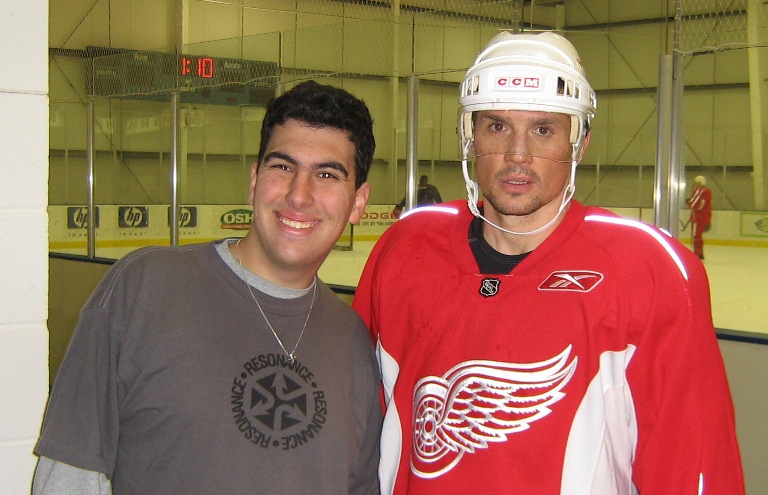
Dinur sent me this photo from the Sharks-Wings game a few nights ago. This is what happens when you become friends with your students. They get cheeky. They send you obnoxious sports photos. They stop asking you questions about social science and start asking you questions like:

Do the Red Wings dislike Osgood? Dominik Hasek plays roughly 2/3 of the team's games, and with the exception of tonight, has a phenomenal season (his GAA before tonight was 1.80, and he was 2nd in the league with 5 shutouts). On nights he doesn't play, the Wings list him as a scratch, and start a guy by the name of Joey MacDonald (sorry, I thought Jimmy Howard, he was the backup last year). They scratch Hasek so that there's no chance of him seeing ice time if he's not the starter. Osgood rarely (if ever) starts for the team any more. Do you think it's just the team grooming a goalie for the future in MacDonald, or do they not think highly of Ozzie in the organization any more?

You see, that cheeky little bastard Dinur knows that I’m a really big fan of Chris Osgood’s. In the realm of male sports banter, that’s called a liability. You see, it’s not that Chris Osgood is that bad. It’s just that he’s not that good. There’s the essential rub. You see, Chris Osgood can be a completely inspired player. He makes some exceptional saves. Back in 1999, I remember my friend Baron Bryan (he’s not Irish—in fact, Bryan is a corruption of Ibrahim—he’s Lebanese! He’s an airline pilot and a hockey goalie, really good-looking and a lot of fun to drink with—I taught him the Arabic alphabet) saying, “Yeah, you see, Osgood will make a great save like that one and then turn around and let in a soft goal later that evening.” Even back in ’99 I’d get flack like that.

When I first became a Wings fan in ’98, I wasn’t really impressed with Osgood until I saw him play live in DC. He’s the most gloriously alive goalie I’ve ever watched. He’s about my height, so he’s not very big for a goalie. He looks like a small tiger when he’s in net. Any goalie can look focused on camera. But off-camera, most goalies stand around looking bored while the puck’s on the other half of the ice. I mean, watching Olaf Kolzig, I swear he could be thinking, “I am so fucking bored [swig of water from sports bottle]. You know, I could be jacking off right now.” Never Chris Osgood. He’s focused every moment he’s in net. He never takes his eyes off the puck. He’s excited. He fucking loves hockey and that’s why I love him. He’s a great sport. No ego, no bullshit. Completely focused on the game. Loves Detroit and his teammates. Couldn’t wait to get back.

To answer your question, Dinur, after that last slump he had that led them to pick up Hasek, I think that the Wings management decided that they wanted a star goalie, which is why they’ve been infatuated with Hasek. Hasek sucked, so they gave Manny Legace a chance, but Legace fell apart in the playoffs. Playoff hockey is like regular season football: each game isn’t purely decisive, but every game counts seriously. The victory in the here and now is absolutely essential. It’s a totally different psychology. Yeah, there was lots of other stuff wrong last year, but Legace’s performance was the most damning part of the Wings’ playoffs fizzle. So they axed Legace. Chris wanted back in, badly enough to take the humiliation. So unless something goes hideously wrong with Red Wings goaltending, I’ve got to think he’s permanently out. He came back for cheap, so they won’t fire him. But he’s dead-ended. They decided after that last slump that he was a nice guy, but he doesn’t have the makings of a legendary goalie. They want a fucking legend.

I love Chris Osgood because he’s a value-rational player. He doesn’t play hockey for the money or for trophies. He plays because he loves the game and he loves his teammates. That’s the reason you play—for the game itself and for the love of your teammates. That’s life in a nutshell—the quest to grow and express the form and the love of those who share the quest. I’ll always cherish Chris Osgood for that. His example made me a better person.

Plus, he’s kinda cute. And I remember the old days.

Wednesday, December 27, 2006

The Fog Rolls Back In


Well, it’s back to the drawing board. I stopped taking Adderall XR about three days ago. It increases my naturally high level of irritability to hypersensitive levels. Poor Craig has survived me in the last month of the term with the drug in my system and it’s been hell for both of us. Enough is enough. I need to write an e-mail to Dr. Thompson, my psychiatrist and see what he says. Hopefully he may have some ideas between now and when we meet in roughly two weeks.

<

So the drug’s gone, I’m tired, I think a little less clearly and the fog is rolling back in. It’s not that it ever rolled out—that will never happen again—but now it’s thick again.

Sorry to whine so much. I’ll write something interesting soon. But probably I won’t write as much as I have been. Fuck it all.

Friday, December 08, 2006

Time without Charisma


I think I get it now. Charisma is the emotional experience of believing that you can harness the sort of limitless potential that might be attributed to a deity to transform the world creatively. It is the emotional experience of the new possibility for power felt as liberation from the emotional perception of frustration and monotony derived from the limitations of ordinary life, a frustration that derives from an existential disappointment with life that derives from a tendency of the human imagination to create one-sided images.

The images humans we create evoke strong emotion, the imagination offers hope against life’s many intractable difficulties. However, because the imagination’s images are invariably one-sided, in practice, any attempt to transform the world in accordance with the image meets significant frustration. As most such attempts are bound to failure, this augments the emotional response of excitement when such an attempt appears to work. Weber suggests that this emotion is exceptionally difficult to sustain as the idea becomes an accepted part of mundane, everyday life. The legitimating effect of charisma is not sustainable over time.

Yeah, well fuck that, I thought. Starting when I was very young, I liked the experience of power, the ability to transform objects creatively. Everyday life was boring. I hated its mundane routine. So, sublimely unaware of what I was really feeling or what I felt, I gravitated toward what felt good: the ability to transform objects, particularly myself. I sought to constantly transform myself, to always be becoming. Perpetual revolution. Seeing the change happen liberated me from mundane routine. Yes, I lived by other patterns, highly regimented patterns. But the patterns were my own, not the world’s. And they didn’t bore me because unlike the world’s patterns, they gave me the experience of power.

MS changed that by slowing my ability to work. I couldn’t really cut back my work, so what happened is that the pace slowed and my ability to focus in sustained bursts, the thing that makes change happen before your eyes. Now change never happens before my eyes. Everything blends into everything else. Life is unpunctuated, feels as if it has no clear segments. It’s, well, a slow boring of hard boards. It takes passion and perspective. I need the passion to keep plugging away. I need the perspective to accept the pace.

The sense that I was always becoming was illusory, as it was largely an effect of making change fit into specific compressed periods. It was the imposition of that structure onto the experience that provided the experience of charisma. I made sure I could see it happen in a way that felt very responsive to my will. The feeling that I just “am” is just as illusory. I’m changing. I’m just not doing it fast enough to generate that ecstatic feeling. But it has other compensations. I’m not bored. So maybe I can be okay with this. Maybe a slow boring of hard boards won’t drive me nuts. I have to think about that.

Thursday, November 16, 2006

A Question of Discipline

Lenny Sanchez, one of my students, came by to go over his last paper and plot strategy for his next one. When talking about future iterations of the course, he suggested to me that one way I might work more classroom dialogue into the class is by reducing my coverage of history by as much as half and making students much more accountable for their reading in order to obtain historical knowledge. The need to make more time for discussion is vital. Where we’ve had most of the open discussion is during the prep sessions. But it’s at that point that they’re most able to actually discuss the material, as they begin to argue with a background of knowledge. And the dialogues are superb. We do need more of those moments, though. Two or three a term isn't enough.

Of course this constructive engagement comes to me by way of one of the most methodical undergraduate students I’ve met in my career. I can count on Lenny to read. The same is not true of most undergraduates. But his point is well taken—I do mirror their reading a great deal. The current system is not adding as much value as it could. Lenny asked me what the central message of the course was. I told him that the central message is that while the content of any prejudice is entirely constructed, prejudice itself is endemic to human nature. The content of a particular prejudice is taught, but in the absence of that teaching, we’d simply go ahead and create new prejudices reflexively. The most that we can do is to internalize the discipline of trying to control our bias. This is a lifelong struggle. We will never be beyond the effect of prejudice. Lenny’s response was to say that my core message is getting lost in the history. What could be more disturbing for a teacher?

The multiple choice quiz is undoubtedly unpopular. What I used to do for students in the writing link is make them timeline, which frankly, seems to me to be far more work. Yet I’ve never encountered the resistance to the timeline that I do to the multiple choice quiz. It’s as if the students resent the very fact that they are required to use their memory. That itself I find offensive. One can’t speak coherently about the facts if one doesn’t know them. Yet if it is my goal to better prepare them for the paper, I personally think the timeline is more beneficial. Perhaps I should return to that.

I’ve never really liked the idea, but I might try using the Socratic method and just randomly call on people to present the material and assume they’ve internalized the data on a level necessary to discuss it. I don’t know quite what to do yet. I do know that I can’t teach this the way I teach an intro level class. In order to understand this, they must reach a higher level of discipline. If they don’t attain that discipline needed to understand it, it is definitely better that they not attempt it at all. I actively prefer that they not. The half-baked idiotically loose images that people have of this conflict are a core part of why it is so lethal. I refuse to become part of the problem. But Ellis has always made a point of telling me, “Look, Talal, I understand what you’re saying. But that isn’t going to shut down their curiosity. They’re still going to look for an easy answer. Slapping their hand and telling them to behave isn’t going to solve the problem.”

At the start of term, Glenn Mackin and I were having a conversation. He suggested that the ideas are what make the detail worthwhile. But the difficulty is that one can’t understand these particular ideas well without a strong command of the detail. But I need to find some way of making them want to master the detail. What they want is a fun little pseudo-seminar where they get a smattering of the tastes and colors of the ideas and get to play with them and explore. That’s absolutely out of the question. That said, there is a place for play and exploration, even with ideas as potentially lethal as these. But I’m having trouble finding the boundaries.

How do you make someone want an arsenal of facts at their command?

Thursday, September 14, 2006

Acceptance

Something has changed. It happened slowly, but it’s there.

I’ve been dealing with some of the harder emotions I go through in the set. I’m unemployed this month and we’re short on money. I have a lot of shame issues tied to my financial problems, almost all of which stem from the very serious damage MS has done to the cognitive faculties that make discipline possible. I’m very bad at organization now too, and organizing files and sorting old mail can border on the traumatic for me. It’s a strange disease.

A few years ago, when I moved in with Craig, my mother very unceremoniously took all of my files out of their plastic $35 file boxes, kept the file boxes and crammed the files into a couple of cardboard boxes and shipped them to me book rate. I had to put them in the garage unopened. I had no filing resources and no space inside the house or at my office at school (for the first year Craig and I were together, I still had an office).

I was afraid of opening them because I knew the emotions would gush out at me. I have lots of family of origin issues to begin with. But being confronted with my organizational work from before the illness is always very hard for me, because my gifts for organization were truly extraordinary. I was damned good. I was the kwisatz hadedrach: he who can be many places at once. That’s what good organization does. Organization lets you live in many contexts. And as the self is defined with respect to those many contexts, in a way, it gives you more self. More facets of your self are clearly defined with respect to other times and spaces. You become an integrator of contexts. It’s a powerful high. I miss it more than almost anything else the disease has cost me.

Today I opened the boxes. My files were amazing. I had a file on every country between Morocco and China. Many were thick. EIU reports, news clips, articles on democratization, country studies—good shit. I know see why so many people felt threatened by me. I was actually doing a fairly creditable job of tracking democracy in all the countries between Morocco and China! But I was only a little emotionally overwhelmed, and not with feelings of shame and remorse. Of course, I had to throw most of them away. I kept the Arab world ones. I threw out the remainder. I know I’ll never get around to becoming an Asian specialist. I’m too limited. I’m not the kwisatz haderach anymore. I can’t be many places at once. Not being in any of those places, I need not be defined with respect to them. Simply put, I don’t need all those files anymore.

So many of the files never got used, but this time I didn’t feel remorse at the waste. I was pretty floored by the size of the gap between my abilities then and now, but for the first time, I wasn’t floored emotionally. I wasn’t feeling the overwhelming feelings of regret, sorrow and shame that have haunted me for the past seven or eight of my life. I was just floored intellectually. It was a thought that went something like, “Yeah. Damn. It was real. You really were that good. If you could still do what you did then, you’d be an assistant professor already. You’d be published and have presented slews of papers.” For the first time, though, I didn’t feel despair.

Instead, I realized that for years now I’ve been whipping myself to just get over it. I’ve felt the deepest shame in that in the years since the diagnosis, barely a day went by when I didn’t berate myself for not having come to acceptance of this situation and having moved on. I think today I realized that the whole point is that you don’t just get over a loss of this magnitude. You grieve. You can only stop grieving when you understand what you have lost truly and when you begin to make new attachments that can give meaning to your life. When the loss is this big, the process takes years. I was the kwisatz haderach. You don’t just snap your fingers and get over something like that.

You see, I lost myself. The only way I’ve been able to cope was to say who I was died and that I was a different person, because so long as I clung to the old Talal’s values, I could never be happy being the person the disease made me. My Aunt Charlotte objected to this. She told me, “You may feel as if the person you were is gone, but you are still the sweet, loving boy you always were. I recognize you.” You didn’t die.

But that’s the rub. It took me a very long time to grasp it in therapy. One of the things I resented very deeply was, ironically, how much more people liked me after I got sick. That’s simply natural. Not being the kwisatz haderach makes a guy way less intimidating. But I was also hurt in that I felt that living up to all the ideals that I lived up to was what made people like me and was afraid that once I couldn’t live up to those ideals, they would be as disappointed in me as I was in myself. It turned out that no one cared. I wondered why I’d worked so hard. Was it all meaningless? My therapist Micheal pointed out, “Living up to all those ideals was what made you like you. Other people like you because you are loving.” So at some levels, then, score one for Auntie Char.

But I lost the self that I valued. So no one else gave a shit about that guy and feel that the only difference is that I’m more loving. Getting to be that guy every day was the reason I woke up every morning. I loved it. Yeah, there were hard moments, but I was the kwisatz haderach. Imagine zapping Superman with kryptonite, taking away all of his powers and saying, “Hey, Clark. Chill, dude. You’re still a hell of an investigative reporter. You may still win a Pulitzer (fuck, Tom Friedman has two—you gotta be able to beat him, right?). And you’re a really great guy, everybody likes you. And you could still bag Lois one day. It could happen.” I mean, the guy could fly! What the hell is winning a Pulitzer compared to that?

I mean fuck that shit! My creative power was what I cherished most about myself and it’s taken a permanent hit. Grieving wasn’t an indulgence. It was a necessity. The loss to me was enormous. Yeah, no one else misses the guy. But I will, probably for the rest of my life. Cause he was me and not just any me. He was the me that I wanted to be (Sweet Lord, I’m starting to rhyme. Shoot me).

If I’m to be a good Catholic boy (and despite the sex, I keep coming back to it, so I guess I’m a still a believer) I’d probably say that the aspect of Himself that God wishes for us to emulate is His capacity to love, not his ability to create. God wishes us to be concerned with loving, not power, creative or otherwise. But I love creative power. That’s the part of God I want to be like. Well, God has a tremendous sense of economy and has used this illness for my spiritual betterment. So being loving it is. I always said that’s what my life is about. Now I have to mean it. And doing it isn’t so hard. The disease has made all the changes for me. I need only accept it. I guess I do. I’ll try.

Friday, July 07, 2006

Flotsam, Jetsam and a Lack of Focus

POLS 325 started a couple of weeks ago and, like any new course, is taking over my workaday life. My blogging focus is absolutely shot and the blog is going to hell. My apologies to my seven readers a day. You deserve more loyalty. So this is the whirlwind of blurry events and the emotions that accompanied them.


Iraq vets return homeless

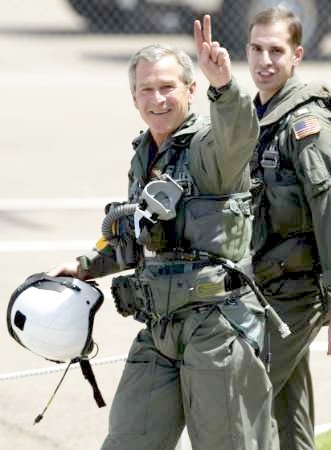
According to the Associated Press we now have homeless vets for this war. That dickless bastard Bush is all game for venerating the masculinity of military men when it means he gets to dress up, land on an aircraft carrier and proclaim “Mission accomplished” as if he personally risked his life to invade Iraq. But the poor bastards who have to fight this war are coming back from multiple tours with PTSD, missing limbs and now, are winding up homeless. Yes, I understand that the problem of homeless veterans antedates the administration of Bush the Younger. But the cold reality of this war is that we do not have anything near the troop level to create a stable state in Iraq. Without more men, I just can’t see us creating a stable state in Iraq. I don’t imagine Bush’s courage for strutting on aircraft carriers will extend to instituting a draft.

The blood of our military is being spilled on a foreign adventure on which we should not have embarked and that we do not have the commitment to win. After Vietnam, I thought we’d learned our lesson about engaging in futile adventures for the gratification of ideologues and corporations. But those who do not learn from history are doomed to repeat it and we are a people who dislike history. My prediction is that, as was the case in Vietnam, several administrations will change without a change in policy and we will wind up pulling out without achieving our objective. How sad to see that we have learned absolutely nothing and that the soldiers whose lives are risked in this adventure can look forward to homelessness as well as losing life and limb.


Stevie Y retired

Steve Yzerman, beloved captain of the Detroit Red Wings, retired last week. It’s the end of an era. He represented everything that makes hockey a great sport. Two decades ago, when Steve Yzerman started playing, the Wings were a joke. Now they’re a dynasty. Yzerman provided the strongest type of leadership: peerless example. There are all sorts of trophies I could mention and stats I could site. But I think the one that matters the most is that he holds the team’s record for assists (1,063), the seventh highest in league history. Yzerman put the team before everything else and the Detroit Red Wings became a great team because of it. We will never see his like again.

As of earlier this year, I can now claim a single degree of separation from Stevie Y as Dinur got to meet him:


Pundits disagree on the Packers future karma

Cliff Christl says the Pack is going to suck. He could care less about the state of our offensive line and is hung up on whether Ahman Green will be any good, because Najeh Davenport and Samkon Gado apparently have no potential. What I love about Christl is that he admits that he doesn’t even really like pro-football and only watches it because he’s paid to. I prefer the cautiously optimistic analysis of PackerReport.com’s Tyler Dunne, who basically says that the big question mark is the offensive line and, if it gets together, Green, Davenport and Gado could make for a formidable running game. Granted, my intelligence strategy is sadly much the same as that of the Bush administration: I believe only the analysts who agree with my position. But I have never claimed any particular rationality in the realm of sports fandom. Fuck Cliff Christl. GO PACK!!!!

Kirk and I have been trading football related e-mails

Shocking news, eh? What with the start of football season and all (by the by, if any of my buddies are reading this and would like in on our fantasy football league, let me know. Dinur has already joined). Kirk recently sent me an e-mail with an article from his favorite fantasy football site, the coldhardfootballfacts.com, detailing the sex habits of bachelor NFL QBs. Back when I thought I was straight, I thought that Joe Namath was the ideal quarterback personality, both on and off the field. It is said that on his deathbed, Vince Lombardi called out in a fevered nightmare, “You aren’t bigger than football Joe Namath!”

Well, I’m queer now, so my ideal of a football playing stud has changed somewhat, so I wrote back a completely gratuitous letter completely charged with queer innuendo. Kirk is the only straight boy I know who can take this humor. Sadly, most other queers don’t like football, so the whole Vikings angle is lost on them.

Dear Kirk,

I need to start plugging and chugging stats. I'm never going to be worthy competition while I have no decent analysis of the total football situation.

My view of football players has changed somewhat over the past few years. I still like Joe Namath's attitude toward sex and drugs, but he's way too interested in chicks for my taste. I definitely think we need more hardcore queer players. Unlike the straight chumps we see now (the Minnesota Vikings come to mind) queers know how to stage-manage an orgy. You don't read about queers sexually assaulting the attendants at a bathhouse and, indeed, the attendants at a bathhouse don't get shocked when guys whip it out and get to work. When queers want to have an orgy on a boat (we call them "gay cruises") the attendants are well paid, know what to expect and don't complain. Indeed, because we are used to having orgies, we don't go wild and rape Gopher the Yeoman-Purser on the shuffleboard deck. After all, there are PLENTY of other guys who'd like to be fucked on the shuffleboard deck, many of them who'd love to playact being raped, if that's what you're into. Plus, on a gay cruise, there's always plenty of liquor and great food for between fucks because QUEERS PLAN.

The Vikings, apparently, don't even have the good sense to tip off the boat's owners and staff as to what they want to do on the boat. I mean, with that sort of stage management, is it any wonder that they all got fined? It's a miracle that they managed to beat us twice last year. I might be okay with it if the Packers were having great locker room sex (and sent me a video, or better, hired me to be their full-service towel boy). But the only thing that sucks about the Packers is their uptight obsession with family values.

And, of course, last year's offensive line. That sucked too, and not in that fun queer sorta way.

Your pal,

Talal

Other news

My buddy Fares from back at Georgetown flies in this week. I’m really pumped. I haven’t seen him since Christmas of ’97!

Tuesday, May 23, 2006

Mere Mortality

If pressed, I think many graduate students will admit that there are always important books on the exam list that we never wind up reading. Indeed, if pressed, we will admit that we know that we never will read the damned book, especially after passing our comps. You listen in seminar, you learn a few canned remarks to bring up when the book is mentioned and you dodge it. Maybe the first time you wanted to read it, but you just didn’t get there that week. I know we’ve all been there. The next time you encounter the book, it winds up assigned in a similar bad week. But you’ve bluffed your way through once before and it’s easier to fake it the next time. After all, you remember what everyone said last time and seminar often winds up being the same tired conversation with the same tired subplots and variations. Yadda, yadda. You know the drill.

And each time you get by without reading it it gets easier to blow it off the next time. Following the impeccable logic of Italo Calvino, you hear the book summarized so often that it becomes as if you did read simply because everyone else has. But you didn’t read it and you know what seminar analysis is really worth. You know if there is something there, that unless you read it and rip it apart yourself, that you aren’t really going to get it. So sometimes you finally read it out of guilt. And sometimes you decide the book was probably an overrated piece of shit anyway, so you yawn, stretch, say “Oh well” in that most self-satisfied and smug of tones and move on. Hobbes defines contempt as being utterly unable to be made to prefer an object, no matter what other object you could choose in its place. It can be an easy emotion to take toward a book.

Every now and then a student in one of your classes makes it by that way. It’s a little more irksome given how much less reading there is. This is especially true in many of my intro classes because, being focused on critical reading, I really care about them ripping one text apart, as opposed to absorbing facts from many texts. As a teacher, you try to individualize the system as much as possible to make sure that each student, especially they highly gifted ones, are challenged at the frontier of their skill set. But, you have to create a system that is fair to the whole class and that means one of the smart ones is eventually going to slip through. But I do my damndest and am proud of my success.

One of the shortcomings of my personality is that I’m a harder working teacher than I am a student. Admittedly, the former is a more satisfying, creative job. Plus the incentive structure is such that you can’t be a good teacher unless you prepare thoroughly. You can’t bluff being the teacher. It shows. Being a student is similar, but the logic of defection is easier. There are twenty other students. The teacher knows if you haven’t prepared. But when the rest of the students haven’t prepared either, there’s lots of room to hide from individual accountability.

Well, life is basically God’s course. And he’s a really, really efficient teacher. The Good Lord has a ruthless sense of economy and the course is perfectly individualized and the instructor is quite patient. If you skip a book that you’re supposed to read and bluff your way through seminar, He’ll eventually find a way to get you to read it. He can wait. I don’t know what the Good Lord calls the book that I’ve been avoiding, but I call it Mere Mortality. Perhaps when I’ve learned the lesson I’ll call it something less melodramatic. But I’ve been interested in the Heroic Ideals part of the syllabus. I’m good at that shit. Fuck Mere Mortality. Who the hell wants to read that?

When I was young, I was really good at bluffing my way through that week on the syllabus. Yes, I acknowledged that I was finite in my mind. Of course I had limitations. I’m a klutzy geek; it is clear, for example, that I will not be an athlete. When I joined the queer rugby team, it became rather apparent that if I wanted any prayer of keeping up with the other guys on the pitch (I kept up at the pub quite nicely, thank you) I would need to quit graduate school and go to every single supplemental run in the hopes of building up some athletic ability. It took me about a month to make the decision, because I love those guys and graduate school really sucks. Being unable to organize my way out of a wet paper bag, I wasn’t even able to be a good fan. That hurt way more than not being an athlete. Accepting physical limitation has always been easy for me.

But I believed, in my heart, that there were spheres in which I could achieve what I imagined. So long as I felt that I could control those spheres, that I was not subject to limitation in them, then I was content. Yes, I knew in my mind that there were limits in those spheres. But I didn’t have to look at those limits in any real emotional sense because I could do so much more than anyone else I knew. It wasn’t that I needed to be better than others as a thing in itself. That’s tacky, egocentric and unloving. I wasn’t that crude. But I needed to know that I was better because it meant that I was damned good and I couldn’t live without knowing that I was damned good. I can’t bear to plod. But plodding is relative. To know whether or not you’re plodding, you need reference points. Yeah, I acknowledge that you can’t both want to be better than everyone else and not want to be better, but feelings don’t resolve themselves into neat rational categories. People only bring their feelings in contact with reason when life forces them to. For that reason, God has given me the gift of multiple sclerosis, which brings my feelings into direct analysis. No really, mere mortality. You’re going to read this one.

He knows that I’m good at bluffing my way through seminar and mouthing the correct words. When I took my methods course with Mark Smith, Mark used to give us these question lists to prepare for seminar. He even made us read over Christmas. He freaked me out as a first year student, because I thought he was raising the bar, that if I didn’t know the answer to every question, I hadn’t prepared for class and I’d get raked over the coals. So I knew most of the answers going in. When people didn’t answer, I did, Mark called me into his office and suggested to me, in that soft-spoken voice of his, that moments of silence sometimes help the other students think things through and get to their answer. He looked like he hated saying it to me more than I hated hearing it. I suck at staying quiet. So the next seminar I took with Mark, I made sure I didn’t talk too much by handicapping myself. I didn’t buy the textbooks and I didn’t read for class. I spent the first two-thirds of the seminar listening to the other students’ comments and debate, piecing together what the text must have argued. At the end of the class session, I’d just make some nifty incisive comment, I’d look at Mark, Mark would look at me and we’d have a moment. It was beautiful.

It was beautiful, that is, until about Week 7 or so. The other students were having trouble and kept dancing around central points in the text. Naturally, I inferred the obvious missing point, except apparently the obvious missing point was apparently quite blatantly represented in the text. Mark caught on to what I was doing instantly. To make matters worse, the next week we read Wilson’s completely non-theoretical description of the federal bureaucracy. One can’t infer the argument from a non-theoretical piece. I did my usual routine of providing interpretive insight. But Mark was ready for my particular brand of bullshit and kept asking me for concrete examples from the book. Indeed, Mark looked at me and I looked at Mark and we had a moment. The next week, I bought the damned book and read it. Mark put up with me talking a bit more.

Mere mortality, apparently, is a big deal on the Good Lord’s syllabus. I didn’t read it, so now I get to live it. So I plod. I fuck up. I come to an understanding of my weakness. It still pisses me off. I’m still working it out.

Wednesday, April 05, 2006

The Muse is a Whore

I wrote this to my buddy Sebastian a few weeks ago:

I don't buy that "I have no choice; I'm channeling the muse" shit. The Muse is a whore. She promises everything and delivers nothing. She sets you up on impossible tasks and while you work like a galley slave to achieve them, she’s off fucking some other guy.

Well, I don’t buy it. The Muse is nothing more than the imagination hiding behind the image of an enticing woman so you give her everything she wants. The imagination is a presumptuous, if useful impulse that wants to be in charge of your mind. Fuck that shit. The first thing you do establish control by back-handing the bitch as hard as you can. Then, using strict discipline, you throw her down and fuck her for all she’s worth. A resourceful guy knows just how to fuck her because he can read the meaning of every one of her moans, but at no time do you ever let the bitch have control.

Reason and technique are the ultimate S&M whip.

I think that Nietzsche understood this, which is why he was so inventive and prolific. Of course, Nietzsche virtually never got laid, which is good proof that one should never treat a REAL woman this way. And of course, I used to put women up on pedestals and I never got laid either. That's probably why I like the analogy so much. But I’ve told it to feminist lesbian friends and gotten a smile. And I found the attitude really helps improve productivity and skill. The imagination just asks for too much, too much of the time. It'll drive a guy nuts.

Tuesday, April 04, 2006

A Defense of Brett Favre

I wrote this to my friend Kirk a few days before Christmas:

I don't know about Dudley's article on Favre. The only thing that I agree about is that I really think he should have retired last year. It might have done him some personal good. It's hard for me to love Favre. He's always been something of an asshole. I've worn his jersey for years, because fuck it, he's the star quarterback of the Green Bay Packers, and he's a fucking god. I think dealing with his father and brother-in-law's death, his wife's sickness and his hometown being leveled have done a lot to humanize him. The season has sucked, and believe it or not, I actually feel bad for him on a personal level, and not just for myself because my team sucks. I'd rather he retired last year and and everyone blamed Aaron Rodgers for the big suck.

So yes, we come to the point. The Packers would have sucked this year without Favre and I don't think Favre's the reason our season's sucked. I'm not just being a queer little fanboy. I think you'll recall that I've been very hard on Favre in the past and have often whined and bitched about the game slipping away due to his cockiness. I whined and bitched about it when he was football god and the galaxy went our way and we had winning seasons every year. I've bitched about it since we lost the goddamned Superbowl to the Denver Motherfucking Broncos (to whom, after years of therapy, I am now able to refer by name, rather than choking out "That Team From Colorado"). I call on you to witness that. Just as everyone was willing to shield Favre from criticism when he was winning, so I argue that your John Dudley is ready to lay it on like peanut butter on toast, because there's nothing the media likes better than to frenzy like sharks when someone famous is bleeding. That's one way that sports, politics and Hollywood are covered in the same way.

Let's look at the facts of his career and the structure of this year's Green Bay Packers team. First, Favre has always thrown a somewhat high number of interceptions. I have the stats for 22 QBs in my draft spreadsheet. Averaging their career averages is admittedly not the cleanest statistical move, but I don't have time to do anything more sophisticated at the moment. I should be working on my prospectus rather than self-indulgently writing football letters. But damn it, you can talk such a wonderful amount of shit about football, whereas with politics, because real lives are in the balance, it just hurts too much. I miss that sort of bar-room banter with my buddies. That's been really the only way in which marriage has been a little hard. I don't get to have as much non-sexual male bonding.

Anyway, that admittedly lackluster stats move suggests that the average competitive QB (I tracked the careers of last year's top 30) throws 10 interceptions a year. Favre throws an average of 16. So he's higher than average. Moreover, in his career and has only thrown fewer than 12 in one year: his first with Atlanta. Four years in his career he's thrown over 20. But is that a problem? Not if you throw way many more touchdowns. Doing that same, admittedly poor stats move of taking the average of the averages has our average QB throwing 14 TDs a year. Brett Favre's career average is 27 TDs. Peyton Manning, by the way, has somewhat higher average for interceptions and TDs: 17 and 31 respectively. My theory is that a great quarterback is simply a QB who can maintain pass accuracy while making more attempts. I didn't take career averages on attempts per season for each player when I was preparing for my second abortive fantasy season (I lasted longer this time, though! I'm not a COMPLETE limp-dicked loser. If I can do a little better each year, I might get to finish a season by the time I graduate), but both are on the higher end of the spectrum for 500+ attempts. After all, everyone decent has a rating in the 60s. It's a matter of if you can increase your attempts and maintain that level of accuracy. The good ones can.

There's the rub. Passers don't have unlimited control over their accuracy. Receivers are involved. This is a problem for the Green Bay Packers because WE HAVE NONE. Donald Driver (whose potential, you recall I heralded when he was just a benchwarmer) is good, but he does not an offense make. Receivers are not like the Highlander--there must be more than one. Javon Walker practically died in the first game of the season. Run the ball, you say. There are, after all, other options for scoring in football. Well, fuckin' A, we don't have any running backs either. Ahman Green went out at the start of the season, and between you and me, he's not as young as he used to be. Najeh Davenport went out. Goddamnit, even Gado, our Nigerian Miracle Worker who was doing such an awesome job of just popping out of a clump of defensive players like a young Ahman Green, got injured on Monday night. THERE'S NOBODY LEFT.

What is the cause of this? Well, we started the season with a gaping hole in our offensive line. We lost both Marco Rivera and Mike Wahle to free agency. Sadly, the line has improved a little over the season, but not before we lost two of our top RBs and one wide receiver to injuries. The damage was done. Now this is the heart of the problem. Well, unlike hockey, football is a sport that creates heroes. In hockey, the whole team gets the goal. Yeah the guy who's a leading scorer gets laid, but the truth is most players other than goalies do score occasionally, moreover, the really good players (like Stevie Y) are the ones who know that more assists and more games won is way more important than his or any players' scoring record. Moreover, no one player is pivotal to hockey. A hockey team is a network, a little like the Borg on Star Trek.

Everyone says that Favre works the magic, and its true, he does. But football is fundamentally unfair in that no matter how good your passers, receivers and runners may be, if the line sucks, they're all ground meat. But, ironically, the line can be great and if the backs and receivers all suck, it doesn't matter. So a good O-line is a necessary condition for victory, but it's hardly sufficient. When the action happens, the camera centers on the backs and runners, so either way they get blamed or get the glory. Offensive linemen are just as necessary to victory as a star QB, but they don't get credit or blame. I hope they get laid. Recent team antics on the Minnesota Vikings suggest that isn't a problem. I don't know what everyone is so upset about. If a bunch of teammates want to hire some hookers and have an orgy on a boat, it sounds good for bonding and morale. The only thing I'd do differently is forget the boat and hookers and just get right to it in the locker room. The good stuff's already there.

Anyway, the point is this: No matter how many players it takes to make a successful team, the QB is the ultimate hero. Accordingly, Favre has an ego the size of a Buick. His ego makes him believe that he can make the difference in every game. He doesn't have an ego of the sort that Terrell Owens has--Owens doesn't need the team, doesn't need the line, doesn't need anyone. Owens is an asshole. Favre is a genuine leader. But he believes that no matter what goes wrong, he can compensate. The line goes, no problem, he can handle it. The RBs all die, no problem, he can adapt. No one but Donald Driver to throw to, great, he'll throw Donald a Hail Mary and be back home in time to crack open a beer and throw a steak on the grill. Psychologists call this having "positive illusions." We all have illusions that we believe in to great effect because believing in them helps us adapt when hardship comes along. Try remembering me at USAID or you at that shithole company when that bitch who flashed her rack everywhere left you holding the bag. We both suffered due to our positive illusions, illusions that had previously helped us adapt. It sure sucked ass, didn't it? I LOVE my positive illusions--they're better than weed. And once they're gone, they're gone. You can't buy a nickel bag of positive illusions no matter how good your connections are.

Well, evidence is pretty good that Favre has always had his illusions. He's always tried to pull the miracle out of every bad situation and, often enough, it's worked. But the truth is that his miracles are quite delicate and require a host of talented supporting players. I don't remember if you remember me comparing Favre to Steve Young before he retired. Favre is a fancy player. Young would just do anything to get the ball downfield, even run with it himself if he had to. Favre has actually improved on that front and has shown more practical resourcefulness in recent years. But the truth is he's about the fancy, high tech passing. Just like Liz Taylor can't be Cleopatra without sumptuous wardrobe changes in every scene and a cast of thousands, so Brett Favre can't be THE quarterback without a quality O-line, good receivers and some good RBs to help spread it around (how fucking gay is that analogy... I guess I have changed a little over the past few years, eh?).

But just because you and I know that, it doesn't follow that Favre knows that. So instead of conservatively grinning and bearing it, saying "OK, we have no prayer of winning under these conditions, how do I stoically bear it, making sure we don't look so bad" he tries to pull a miracle out of his hat several times a game. Remember when I said the top QBs are the guys who can increase the number of attempts while maintaining accuracy? Well, he's trying to increase attempts, but there's no way to be accurate with so few passing choices. Favre needs his quality receivers and he's only got Driver. He's trying what's worked in the past, but he's facing his Kobiyashi Maru. He can't win under these circumstances, and he really doesn't know how to play like a respectable loser. He's never lost before. So he throws more hoping to make the magic play and because there's no one to catch the fuckin' ball, he racks up interceptions.

Favre, like many of the assholes who follow him in the media and write articles like the one you forwarded, has always believed that he could work the magic and that he was the magic ingredient. Give him his due--yeah, he is a legendary quarterback. But great quarterbacks don't win games on their own. A team with a great O-line and shit at QB may never be a force to be reckoned with, but a team that has a great QB and no one else in the offense still isn't going to win many games. In all fairness, most of our losses this season have been close. Our defense actually improved from total shit to moderately shitty over the course of the season. And Kirk, I saw almost all the games: my boys went down fighting. Even though we lost, there were some great moments there. They fought a good fight.

But myth is only a myth; legend only a legend. Even drunk Bears fans have to admit that Mike Ditka can't take on a whole football team all by himself. One man versus a team? Fuckin' A, Kirk. Even drunk Bears fans on Saturday Night Live have to admit that's complete bullshit. No, I don't think that Brett Favre and Donald Driver can somehow carry a shitty O-line with no other offensive players, especially with a crummy defense. That sort of miracle is the domain of God alone. Don't think I haven't asked for His help.

Bottom line: Favre is the same guy he's always been. There's no variation at QB. If our O-line and our best receivers and RBs were all out ten years ago, he'd have lost like this ten years ago and probably have been a much different man for the rest of his career. Bottom line: Favre is still a go-to guy. If you want to find blame for the disaster that is this year in Green Bay Packers football, you have to look elsewhere.

Where do I look? Well the first person I blame is Mike Holmgren. He fucking lost the '98 Superbowl and then goes off to become the coach and general manager of the fucking Seahawks because he had to get all of the action into his big, strong hands. He gives up what he openly admits is the best job in football to move to Seattle. And how does he do here? For the entire time he had both jobs, he sucked. I laughed harder and harder every year. Now that he's no longer the GM and has been just the coach for a few years, he's had enough time to work the magic that is by right ours. I have to sit here and goddamn bear it. Even worse, my friend Nimah, who's a Bears fan, can tell me that he's hoping to buy playoff tickets to see the Bears play the Seahawks this winter. This, in my Packers' bar, while I have to watch the Bears score defensive touchdowns on my team's ass. It's just beautiful. The Bears are in the playoffs and the Seahawks dominate the NFC. Gorgeous. My football karma keeps getting better every year.

If Holmgren had stayed and waited two years, he could have been our GM, sucked with us, given up the being GM with us, gone back to just coaching with us and WE'D be back to dominating the NFC. And we'd have loved him for it, because while he might have been a prima donna bastard, he was at least OUR prima donna bastard. And he can win at football.

The other person I blame is Mike Sherman. For most of the years after Sherman left, we still had a superior team. Fuck, we still had a good team last year. And yet there has been no victory.We haven't been back to the Superbowl since Holmgren left. A lot of times the Packers lost because they were cocky. They needed good coaching to regulate that ego. No one was better at holding that in check that Vince Lombardi. Sherman doesn't have Lombardi's gifts, but admittedly, that's an unfair example. Plus, I can hear you saying that in the era of free-agency it takes someone like Belichik to win. I'm not disputing that having a superior sense of value, of finding a way of finding quality, non-star players and molding them into a machine isn't a dominant strategy in today's league. That said, I'd put emphasis on the last element: molding players into a team (I'm not dissing finding good values, mind you, just stressing leadership). If a team is not to be eroded by free agency, it's because it has dynamic leadership that can compensate for that process. Ultimately, that's a rare gift, which is why it is so difficult to form dynasties in this era. But Sherman is not a great coach and our team has been eroded by free agency and our day has passed. If I'm lucky, the Packers may have another rise to glory before I die, but seeing how long passed between when Lombardi won Superbowl II and 1997, I've got to say the odds are against me.

But yeah, I don't think Favre has changed. The team and the times have changed. Except for a little grey hair, Favre hasn't faded. Come on, he threw 30 TDs and 4088 yards last year. Over the past three years he's come to camp leaner and more muscular every year. The difference is that Favre had a team last year and this year, he doesn't.

Your pal,

Talal